
Orthokeratology is the use of specially designed hard gas-permeable contact lenses which you wear at night. While you sleep, the lenses delicately reshape the surface of your cornea in such a way that you can see clearly the whole following day after taking off the lenses in the morning.
Orthokeratological lenses are prescribed in two cases:
- To correct near-sightedness and astigmatism nbsp;
- To stop near-sightedness in children.
Nowadays, many doctors all over the world use orthokeratological lenses to stop near-sightedness in children and teenagers. The studies show that children who use orthokeratological lenses demonstrate a significant slow-down of near-sightedness progression in comparison with those children that use other types of correction. That is why, these lenses are also sometimes called corneal refractive therapy (CRT). This name was first used by an American company Paragon which was the first to develop orthokeratological lenses for night wear.
What Is Corneal Refractive Therapy (СRТ)?
Раrаgon СRТ (Paragon Vision Sciences) is a worldwide orthokeratology brand, which was the first to receive the FDA permission for night use of orthokeratological lenses and developed the design and technology of individual selection of these lenses, which is called corneal refractive therapy (CRT). The lenses of the Paragon Company are made of a unique material, which ensures the high level of their safety, being the thinnest and, consequently, the most comfortable ones today.
How long does the effect from orthokeratological lenses last?
You should be able to see well without glasses and daily contact lenses during the whole day or even two days in a row, sometimes longer. The best and most sustainable result of the correction is achieved when you wear lenses every night.
Which vision issues may be solved with the orthokeratological lenses?
Most often, ortho-lenses are used for temporary correction of near-sightedness (myopia) of up to -6.0 dioptre. Ortho-lenses of a special design may also correct corneal astigmatism, farsightedness and presbyopia.
In any case, after the examination your doctor will professionally discuss this question with you.
Who is a good candidate for orthokeratology?
Most people with light and medium level near-sightedness (with and without astigmatism) are good candidates for orthokeratological correction. As the effect achieved with orthokeratological lenses is reversible, you can at any moment decide either to continue or to stop using these lenses.
Children and young people who do not want to wear glasses but who are still too young for laser correction or have some counter indications are often good candidates for orthokeratology and are very happy with the result.
Soft lenses may cause problems for people who do combat sports or work in polluted conditions; these problems may be easily solved with the help of orthokeratological lenses.
Who does the fitting of orthokeratological lenses?
Orthokeratological lenses must be fitted by ophthalmologists and optometrists who have had special training, certification and experience. It is important to know that orthokeratological lenses are special lenses that may not be bought by prescription.
Which effect do you expect from night correction?
The doctor and the patient always aim to get 100% visual acuity by ortho-lens correction. However, the 90% and 80% vision is also considered to be a good result, because such visual acuity is sufficient for the patient not to require the use of additional correction and to feel confident and comfortable. Clinical trials of Paragon CRT lenses have shown that 93% of the patient get 80% and higher visual acuity and 68% achieve 100% visual acuity and higher.
What should I expect when I start using ortho-lenses?
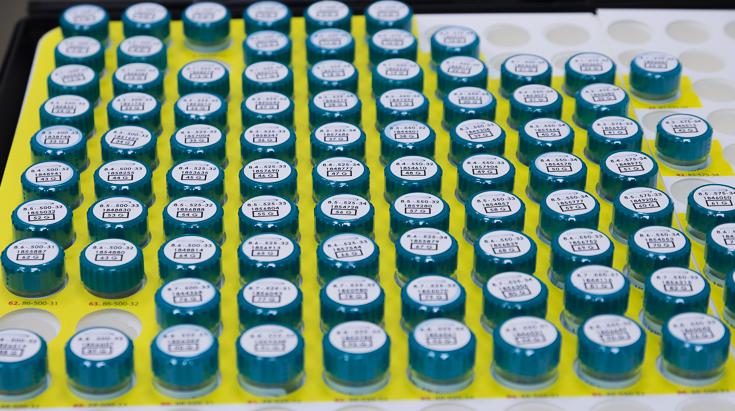
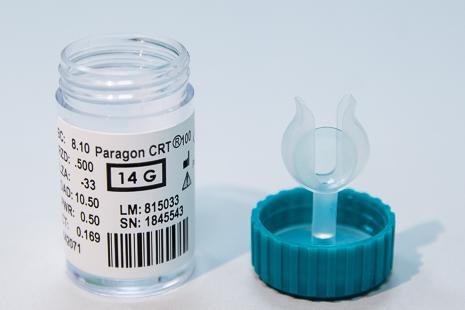
Your doctor will perform the complete examination and decide whether you are a good candidate for orthokeratological correction. In order to do this, the so-called corneal topography (a no-touch and painless analysis of corneal thickness and volume) will be performed. A topographic map of your cornea will be created. Based on the received results, you will be fitted with lenses in accordance with certain fitting nomograms and algorithms. It may be happen that, in order to achieve comfort and high visual acuity, your doctor may need to try a few lenses and select the ones that fit best. In rare cases, the doctor may need to order special lenses for you, which will be customized by the Paragon company to fit your eyes.
At first, you may feel the lenses on your eyes, but very soon these lenses will not cause you any discomfort during the night.
Price
Ortho-lens fitting takes much more time and requires additional knowledge and skills from your doctor. Moreover, you will remain under the supervision of your doctor throughout the whole year. For a year, your doctor will assess not only visual acuity and the state of your cornea but also control whether near-sightedness progresses or not.
All these factors determine the price of the lenses.
How much time is needed to achieve maximum effect?
It depends on many factors, particularly, on the severity of near-sightedness, presence of astigmatism. Some people have perfect vision on the very next morning after wearing lenses for the first time. But the higher the level of near-sightedness the more time is required to achieve maximum possible visual acuity.
Visual acuity will improve every day, and in about 7-10 days you will achieve high quality vision having taken off your lenses right after you wake up. Your vision will remain good during the whole day.
Until you achieve maximum effect from wearing ortho-lenses, you may register (especially in the evening) insufficient contrast levels. However, these unpleasant artefacts will pass with time, when maximum vision is achieved.
Can I have laser correction after using orthokeratological lenses?
Yes. It is possible to perform laser vision correction after you stopped wearing ortho-lenses.
Unlike LASIK, orthokeratological correction is reversible and that is why it can be used for children.

If you decide to have laser correction, you have to stop using orthokeratological lenses and after a few weeks your cornea will return to its initial state and will be ready for laser correction.
Numerous trials have shown that the results of laser correction in patients who used orthokeratological for a long time before the surgery and those who wore glasses are absolutely identical.