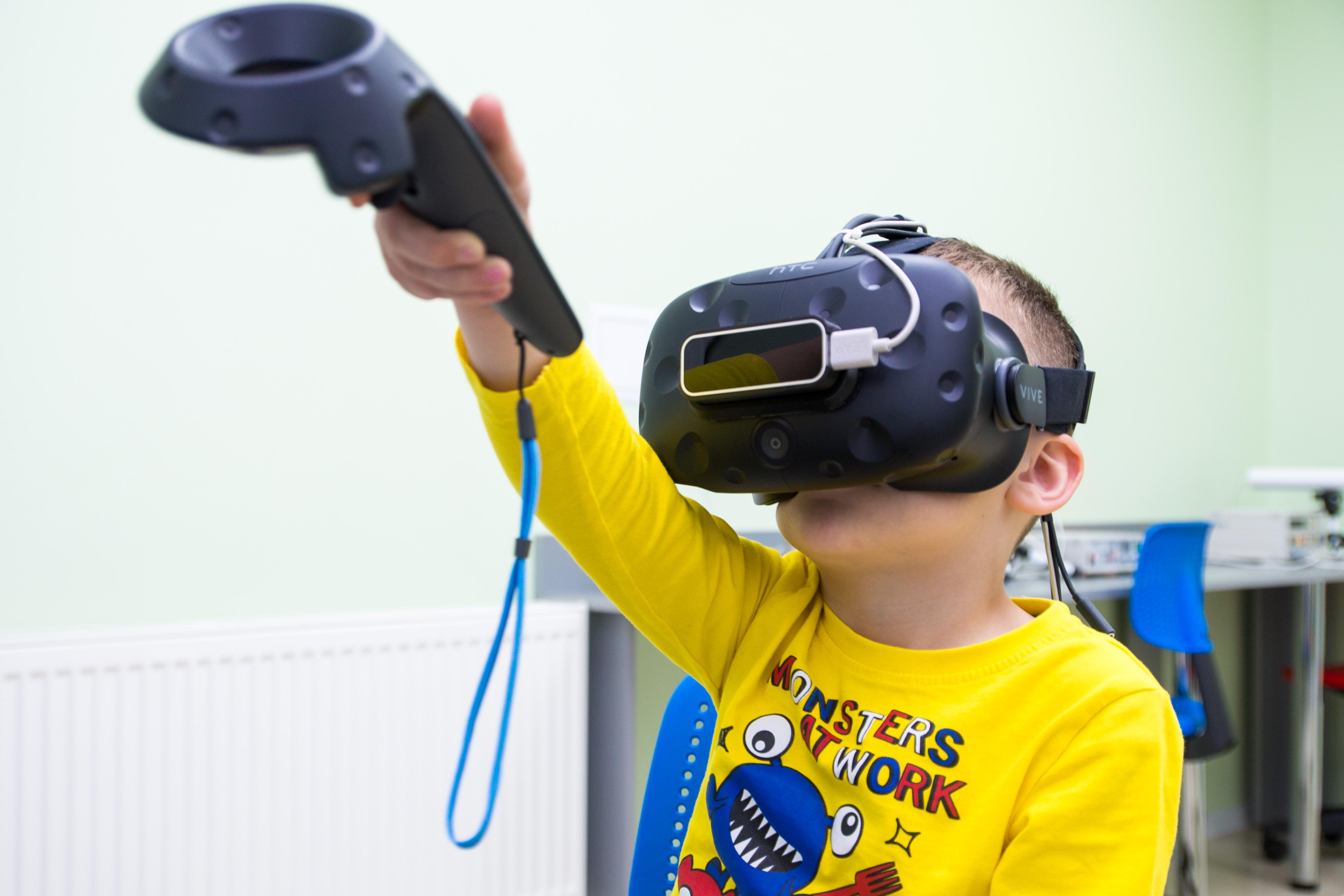
The «Vivid Vision» virtual simulator is a software and hardware complex of visual therapy based on HTC Vive, Oculus Rift и Samsung GearVR virtual reality helmets  used to treat strabismus, amblyopia, convergence insufficiency and other eye diseases in children and adults.
How does visual therapy work?
Putting on a virtual reality helmet, a patient sees an artificial computer world. Sensors monitor the position of the head and arms, that is why, when the patient turns his head or moves his arms, the helmet screens react and shift the image to reflect the patient’s movements in virtual reality. Measuring the vision angle and the image itself, the doctor makes both eyes work together as much as possible, which allows to put two images together and get a stereo-image.
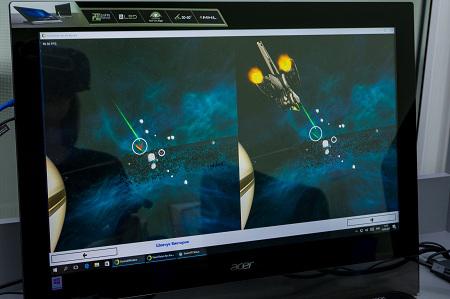 The therapy is conducted in the form of active games; that is why the patient is fully engaged in the process, readily proving feedback. This helps the brain to train the correct position and focus of the eyes, improve the clarity and acuity of distance vision and close-up vision. The effect strengthens and becomes more permanent with every session, vision quality and acuity improves. The procedure is well endured and does not cause any great discomfort. The children are greatly involved in the process, because this is not a boring device with a light bulb, but active games in a bright 3D world.
What do we treat?
1. Strabismus — a disorder in which the eyes look in different directions. In this pathology one or both eyes do not maintain proper alignment, that is why the patient lacks stereoscopic vision – the person does not see a 3-dimensional image. At the beginning of the training, each eye gets its own image under the initial angle, which allows to combine both pictures into one 3D image. In the course of the game, the angle is gradually decreased, changing the strengths of eye muscles and gradually aligning the position of the eyes. As the patient is absorbed in the game, the whole process passes smoothly and without the feeling of discomfort. When the eyes are fully aligned, the training sessions continue to ensure a long-lasting result.
2. Amblyopia (a lazy eye) — a functional decrease of visual acuity in the weak eye. It develops by farsightedness, 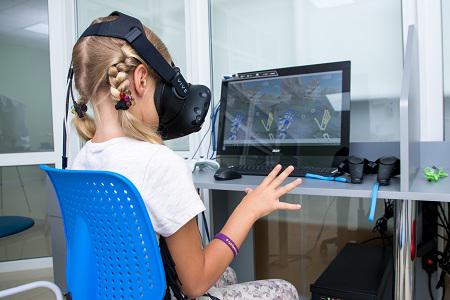 astigmatism, strabismus, that is why the treatment should be combined with the treatment of the cause of the disease. In the course of the training, the image for the better eye is blurred, thus stimulating the work of the weaker eye and stimulating the recovery.
3. Convergence insufficiency is a discomfort experienced while converging the eyes and focusing on nearby objects. Very often it appears in grown-ups when they have hidden accommodation and convergence disorders. This disorder is accompanied by a periodic or constant doubling or blurring when working with nearby objects. The training consists of simultaneous eye convergence and focusing on nearby objects in the gaming medium, which improves the adaptation in conditions of intense visual activity.
4. Eye strain. Interactive and absorbing exercises reduce the fatigue, lower the muscle strain and improve perception.
Since what age can we start?
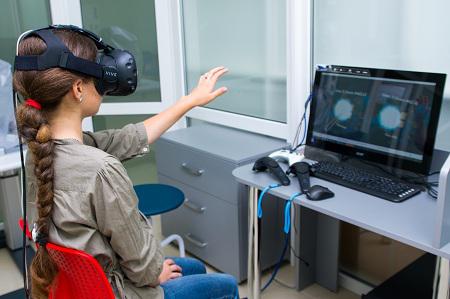 The minimum recommended age is 6 years, when the size and the weight of the helmet does not cause the child discomfort during the training session. Adults may have the training sessions at any age.
What do I start with?
You should first undergo an eye examination to determine the state of your eyes and develop a customized training programme. Then you have the first test session and, based on its results, the training schedule is developed. The programmes range from daily training sessions to once-a-week visits during a 2- or 3-month period.
More information:
Website of the developer www.seevividly.com